Across central London, a growing number of office buildings are being stripped back and rebuilt; not because they are obsolete, but because they can work harder, cleaner, and more efficiently. This shift reflects a new priority for businesses and investors alike: upgrading the city’s commercial infrastructure without adding to its environmental footprint.
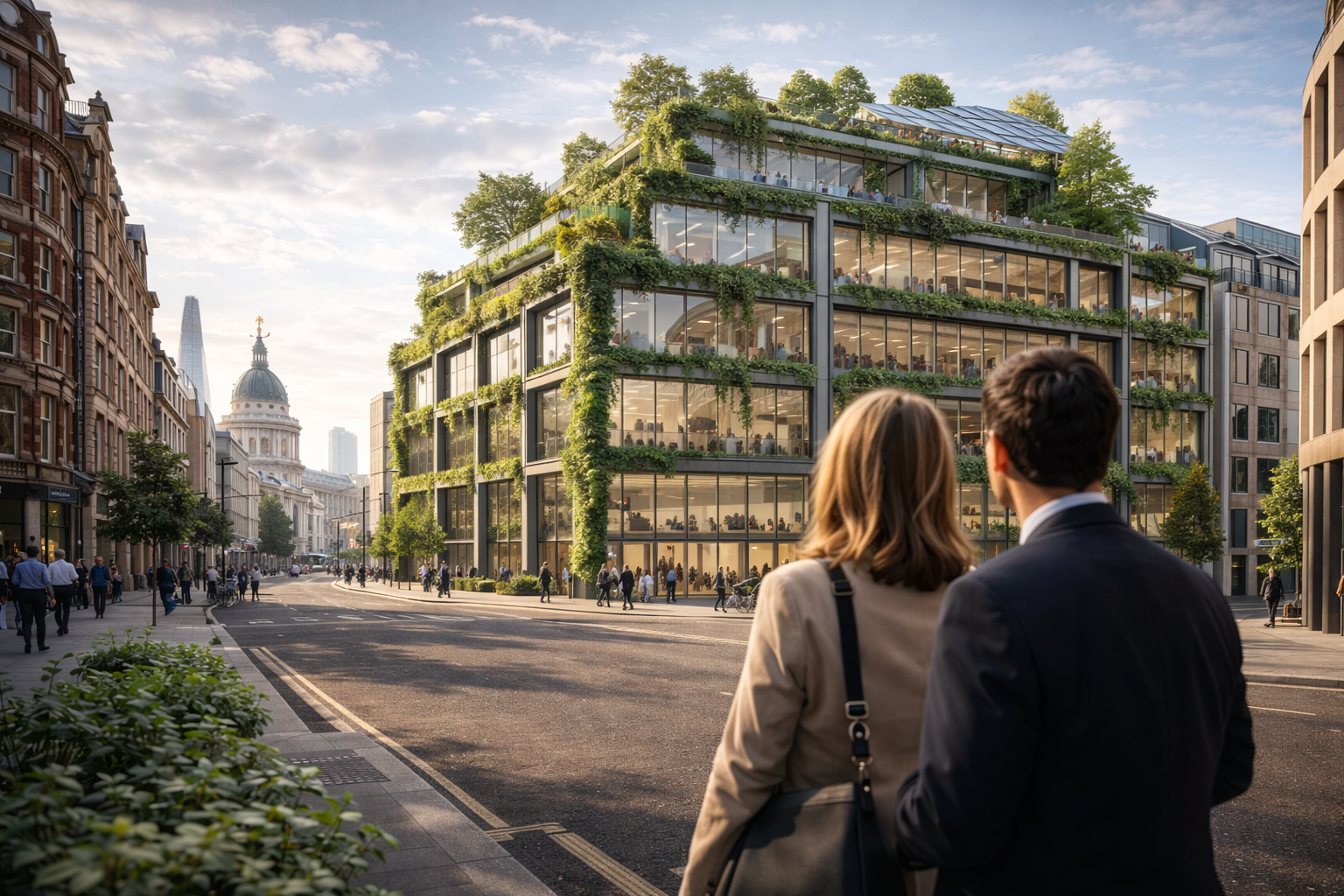
A recent example is the approval of a major green loan to support the transformation of an ageing City office into a modern, low-carbon workplace; a move that reflects a broader, city-wide direction rather than an isolated project.
This shift towards environmentally responsible offices is not just about energy efficiency or compliance. It represents a fundamental change in how businesses choose locations, structure their operations, and prepare for growth in an increasingly competitive and regulated environment.
Why Sustainable Office Projects Are Accelerating Across London
Over the past decade, London has faced mounting pressure to modernise its commercial building stock. Many offices built in the late 20th century no longer meet current environmental standards, employee expectations, or investor requirements. As a result, brown-to-green redevelopments; refurbishing existing buildings rather than demolishing them, have emerged as a practical and scalable solution.
According to a report, ING recently agreed a £170 million loan to support Nuveen’s redevelopment of an office building near St Paul’s Cathedral, transforming it into a high-performance, energy-efficient workspace designed for long-term use.
Projects like these align closely with London’s wider environmental goals, including reduced embodied carbon, improved energy performance, and better utilisation of existing urban infrastructure. For developers and investors, sustainable refurbishment also makes financial sense; greener buildings tend to attract higher-quality tenants and remain viable for longer.
Green Office Redevelopment London as a Business Strategy
Green office redevelopment London is no longer just a property-sector trend; it is increasingly shaping business strategy itself. Organisations are re-evaluating where they operate, how much space they need, and how their workplace supports staff wellbeing, collaboration, and flexibility.
Modern, sustainable offices typically offer:
- Improved air quality and natural light
- Lower operating costs over time
- Greater adaptability for hybrid working models
- Stronger alignment with ESG commitments
For many companies, moving into a redeveloped building is not about prestige; it’s about future-proofing. Regulations around energy efficiency are tightening, and businesses that fail to plan ahead may find themselves constrained by outdated premises sooner than expected.
What This Means for Occupiers and Growing Companies
As more buildings undergo refurbishment, occupiers face decisions that go beyond lease terms. Timing becomes critical. Fit-outs need to be coordinated. Teams may need to operate from temporary locations while redevelopment takes place. In some cases, companies use these moments of transition to reassess workflows, reduce unnecessary assets, or redesign how space is used altogether.
This is where careful logistical planning becomes essential. A workplace transition is not a single event; it is a process involving people, equipment, records, and continuity. Even when sustainability is the headline, operational efficiency determines whether the move supports or disrupts the business.
Industry insight highlights how green financing is accelerating redevelopment timelines across London, meaning businesses must often act quickly when opportunities arise.
The Often-Overlooked Role of Transition and Logistics
Sustainable offices may capture attention, but behind every successful move into a redeveloped building is a series of coordinated actions that rarely make the news. From managing physical assets to ensuring teams remain productive, transitions must be handled with precision.
Relocation is no longer a purely functional task. In the context of sustainability, it can also involve:
- Responsible disposal of outdated furniture and equipment
- Secure handling of sensitive materials
- Temporary storage during phased moves
- Planning around restricted access city locations
As London’s redevelopment activity increases, the ability to move efficiently; often within tight timeframes and complex urban settings; becomes a strategic advantage rather than an afterthought.
How Businesses Navigate Change with Practical Support
This is where experienced support partners quietly add value. While redevelopment reshapes the buildings themselves, specialist providers help organisations adapt to change without unnecessary disruption.
Movevan’s role within evolving London workspaces
Moving van rentals in London to support planned office moves or short-notice transitions
Office relocation services in London for structured, multi-stage workplace changes
Man with a van removal company in London options for smaller offices, departments, or phased relocations
Professional packers and movers to ensure equipment, furniture, and sensitive materials are handled securely
Clearance services for the responsible removal of surplus or outdated office assets
Short- and long-term storage solutions to bridge timing gaps between redevelopment phases and occupancy
These services support continuity; allowing organisations to focus on strategy, people, and growth while the operational details are managed efficiently in the background.
London’s Urban Complexity Adds Another Layer
Relocating within London is unlike moving in most other UK cities. Congestion zones, restricted access hours, listed buildings, and limited loading space all require local knowledge and planning. Redeveloped offices are often located in dense, historic areas where logistics must be handled with care.
As sustainable redevelopment brings new life to central locations, businesses must navigate these complexities smoothly to fully benefit from the upgraded spaces they are moving into.
Looking Ahead: Sustainability and Adaptability Go Hand in Hand
The momentum behind green office redevelopment shows no sign of slowing. As financing, regulation, and occupier demand align, more of London’s older buildings will be transformed rather than replaced. For businesses, this means more choice; but also more decisions.
The organisations that thrive will be those that view change as an opportunity rather than a disruption. Whether adapting to new environmental standards, rethinking workspace design, or relocating into a redeveloped building, preparation and support matter.
Green offices may represent the future of work, but it is thoughtful planning and seamless transitions that allow businesses to make that future work for them.
Credits: Co Star
Leave a Reply